His Majesty King Felipe VI visited the NATO-accredited Counter-Improvised Explosive Devices Centre of Excellence (C-IED CoE), located within the facilities of the Engineers’ Academy Barracks in Hoyo de Manzanares, Madrid.
This visit marks a significant milestone in the history of the Centre and underscores Spain’s continued commitment to NATO, international security, and the global fight against terrorism.
King Felipe VI, who previously visited the Centre in 2012 as the Prince of Asturias, was welcomed by Admiral Teodoro E. López Calderón, Chief of Defence; Colonel Juan Pedro Moral Albaladejo, Commander of the Engineers’ Academy Barracks; and Colonel Javier Corbacho Margallo, Director of the C-IED CoE. Representatives from the twelve nations that contribute to the Centre’s mission were also in attendance.
Following the formal military honours, His Majesty received a detailed briefing on the Centre’s operations, capabilities, and global impact. The presentation emphasized the C-IED CoE’s vital role in supporting NATO’s objectives through its specialized focus on preventing and responding to improvised explosive device (IED) threats.
Since its establishment in 2010, the C-IED CoE has emerged as a leading institution in counter-IED operations. As part of NATO’s defence and security architecture, the Centre works to enhance interoperability among Allied Forces, develop and assess operational doctrines, and test innovative concepts through targeted experimentation.
The Centre is organized according to the three pillars of NATO’s counter-IED doctrine:
Attack the Networks (AtN)
Defeat the Device (DtD)
Prepare the Force (PtF)
Its multidisciplinary teams, including experts in cognitive and cyber domains, collaborate across operational environments to address increasingly sophisticated threats. Looking ahead, the Centre aims to expand its network of Sponsoring Nations and increase its international visibility as a global reference point for C-IED expertise.
During his visit, His Majesty observed a series of live demonstrations that showcased the Centre’s capabilities and cutting-edge technologies in the fight against IEDs:
DEMO 1 – Weapons Intelligence Team (WIT): An outdoor demonstration of technical exploitation tactics using the “Walkthrough IED” system to analyze real-world incident scenarios.
DEMO 2 – Attack the Networks (AtN): A session demonstrating intelligence-driven strategies to disrupt and neutralize terrorist networks that deploy IEDs.
DEMO 3 – C-IED Laboratory: A presentation of R&D projects and emerging technologies, including the use of 3D printing to simulate and analyze IEDs in a secure environment.
DEMO 4 – Document and Media Exploitation (DOMEX): A forensic demonstration of techniques used to extract intelligence from seized electronic devices such as mobile phones, UAVs, and data storage media.
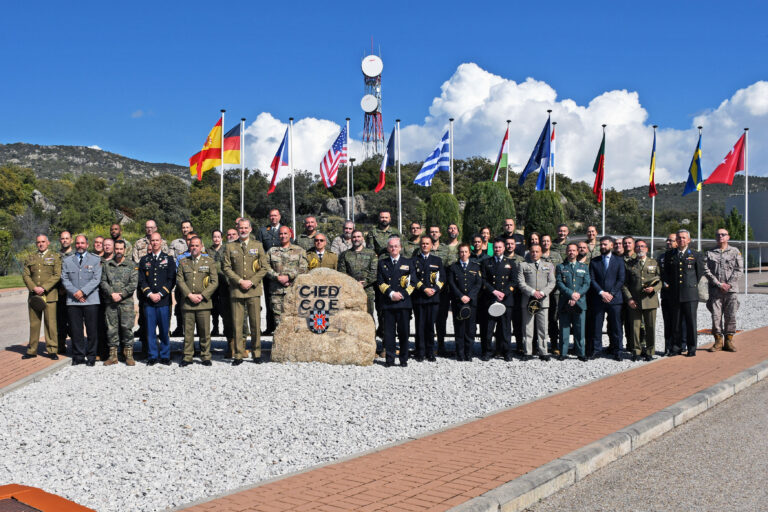
King Felipe VI engaged with members of the international staff, discussing their roles, experiences, and contributions to the Centre’s mission. Before concluding his visit, he signed the Centre’s Book of Honour and posed for a group photo with personnel.
The Counter-Improvised Explosive Devices Centre of Excellence is one of 29 NATO-accredited Centres of Excellence and has been hosted by Spain since 2010. The Centre’s multinational staff, comprising experts from twelve nations, includes both military and civilian personnel with extensive subject-matter knowledge.
The Centre’s core mission is to support NATO, its partners, and the broader international community in countering the IED threat. This includes efforts to mitigate risks posed by terrorist and insurgent networks, as well as evolving challenges in today’s complex security environment.
Following a rigorous re-accreditation process in April 2023, the Centre was evaluated by NATO as “extremely satisfactory,” reaffirming its strategic value to the Alliance.
The C-IED CoE continues its vital mission of saving lives, enhancing operational effectiveness, and strengthening NATO’s collective defence posture in an era of dynamic and unconventional threats.