In September 2007, the Spanish Minister of Defence announced the proposal to establish a Counter-Improvised Explosive Devices Centre of Excellence (C-IED COE), with the goal of creating an international hub dedicated to the fight against terrorism. The center was envisioned not only to enhance the safety and effectiveness of military and civilian personnel involved in operations, but also to strengthen the collective security of North Atlantic Treaty Organization (NATO) allies.
Later that year, the Spanish Chief of Defence formally offered the creation of a multinational C-IED COE to NATO through the Allied Command Transformation (ACT). In 2008, ACT confirmed that the proposed concept fully aligned with NATO principles and standards.
Before the Centre could join NATO’s network of Centres of Excellence, ACT conducted a thorough certification process to ensure that the facilities, capabilities, and readiness met NATO’s high standards. In June 2010, six nations signed the Memorandum of Understanding in Norfolk, Virginia, marking the official launch of the Centre.
Today, the C-IED COE is sponsored by twelve nations: the Czech Republic, France, Germany, Greece, Hungary, the Netherlands, Portugal, Romania, Sweden, Türkiye, the United States, and Spain as the Framework Nation. Canada is currently in the process of joining as an additional sponsoring nation.
The C-IED COE plays a key role in supporting NATO’s Counter-IED Action Plan, which aims to reduce the strategic impact of improvised explosive devices in current and future conflicts by mitigating their tactical and operational effects. Since 2010, the Centre has been actively fulfilling its mission to support NATO and partner nations in developing effective counter-IED strategies and capabilities.

The C-IED COE delivers expert support in the fight against improvised explosive devices (IEDs). We serve NATO, its partner nations, and the international community by enhancing security, reducing the threat of IEDs, and protecting both military personnel and civilian populations, particularly in operational environments where these threats are most prevalent.
The C-IED COE supports a comprehensive approach to counter-IED efforts by integrating expertise across military, law enforcement, intelligence, and academic communities. Through collaboration, innovation, and training, we help develop effective strategies to detect, defeat, and prevent the use of IEDs, especially those deployed by terrorist and insurgent actors.
The Centre continues to reinforce its role in future NATO operations as a key enabler in Multi-Domain C-IED education, doctrine development, and innovation.
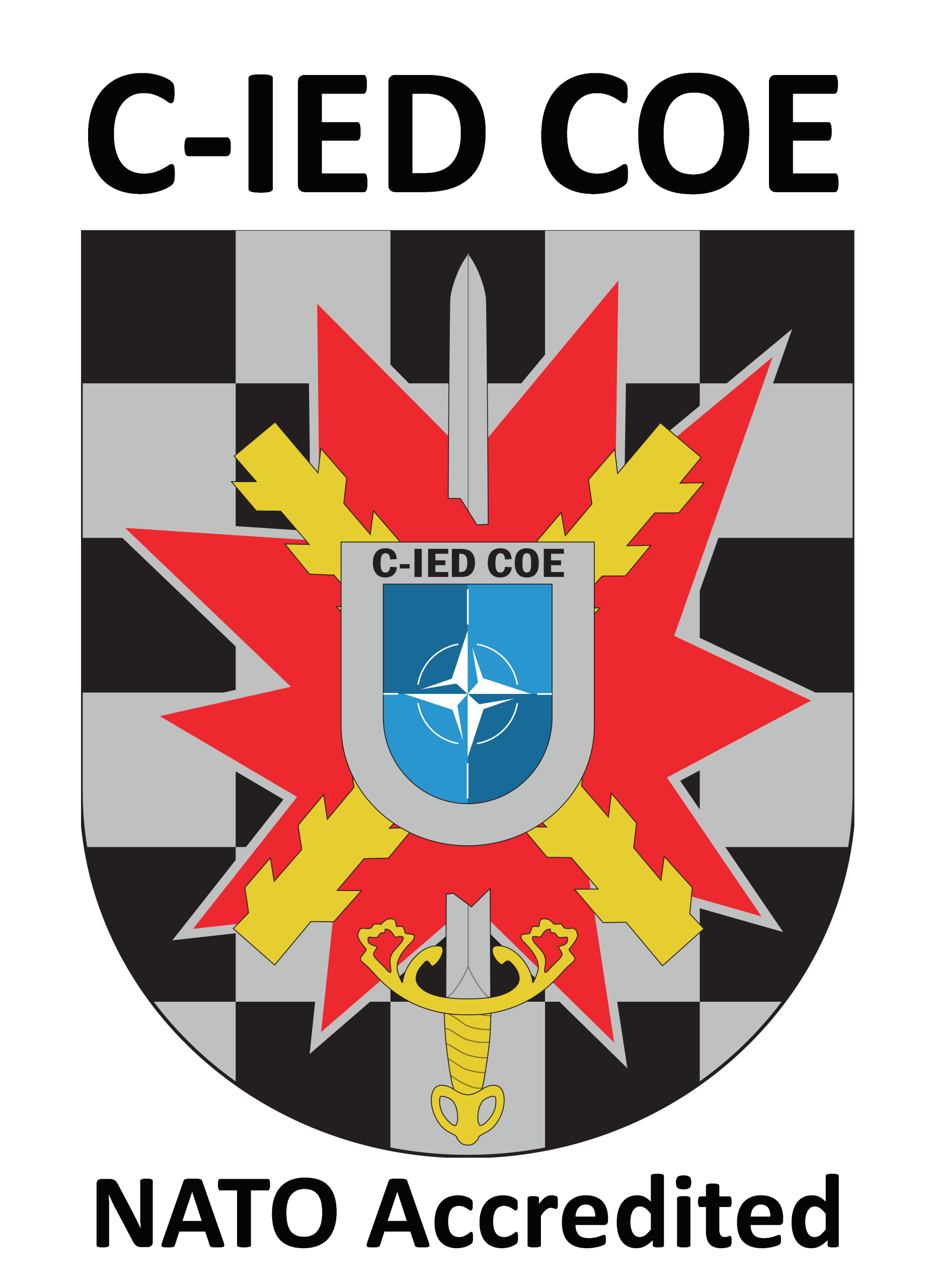
The coat of arms of the Counter-Improvised Explosive Devices Centre of Excellence embodies the Centre’s mission, values, and international character under NATO leadership, with Spain as the Framework Nation.
At its base is a chequy pattern in black and silver, arranged in five and six rows like a chessboard. This symbolizes the Global Approach to countering the threat of terrorism and improvised explosive devices, highlighting the essential coordination between civilian and military components.
A red explosion, edged in silver, dominates the center of the design. The red signifies the destructive force and danger of IEDs, while the silver fillet represents the precision and technological efforts required to detect, disrupt, and defeat these threats.
Crossing the explosion is an upright silver sword, with a gold hilt and pommel, symbolizing the active fight against the IED system and the strength and resolve of those engaged in that fight.
Behind the explosion, the gold Cross of Burgundy, a historic emblem of the Spanish Armed Forces, signifies humility, sacrifice, and tradition. Its presence pays tribute to the enduring commitment of Spain and its armed forces to global security efforts.
At the forefront, the NATO emblem anchors the Centre’s identity within the Alliance. The compass rose, with radiating lines, and the silver border inscribed with “C-IED COE” in black, underscore the Centre’s commitment to NATO principles, doctrine, and its leading role in multinational counter-IED and counter-terrorism operations.
The emblem as a whole reflects the Centre’s operational focus, multinational foundation, and unwavering dedication to protecting lives and enhancing security through the defeat of IED threats.